

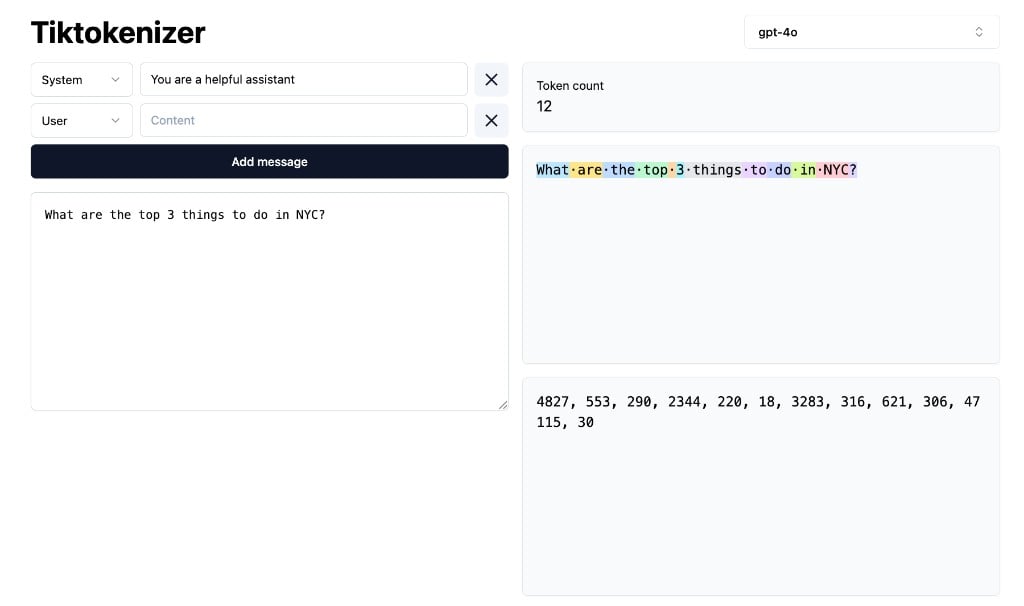
Try it yourself at tiktokenizer.vercel.app.
How a model “reads”
When you read English fluently, you don’t sound out every letter. You see “the” and “have” and “tokenization” as single shapes, and your brain pulls up the meaning in one go. The rare and unfamiliar parts, like “antidisestablishmentarianism” or “solidgoldmagickarp”, you slow down and parse in chunks: anti-dis-establish-ment-arian-ism or solid-gold-magic-karp. A tokenizer does roughly the same thing for an LLM. Common strings get a single ID, rare ones get broken into a handful of subword pieces, and anything weirder than that falls back to individual bytes. Every model’s vocabulary is fixed and determined by the tokenizer—once the tokenizer is trained, nothing more about it is learned at inference time. The trade-off between token length and vocabulary size is straightforward: Using characters as tokens gives you a tiny vocabulary but absurdly long sequences, and the model has to re-derive “h-e-l-l-o means hello” every single time. Using whole words as tokens gives you short sequences but a vocabulary of millions, including separate tokens for typos, novel words, URLs, and rare names. Subwords strike a sweet spot between these two extremes: models typically have ~50,000 to 200,000 tokens in their vocabulary, so every possible input is representable, but common text stays short. A rough rule of thumb for English is that one token ≈ 4 characters ≈ ¾ of a word. So 1,000 tokens is roughly 750 words, or one short page.What tokenization actually does
Tokenization is a two-step process: first, splitting the text into chunks, then looking each chunk up in a table to get an integer ID.Helloandworld(with a leading space) are each one token. The space matters and travels with the word.,and!are their own tokens. Punctuation almost always is, because it’s common enough to warrant its own token ID.- The IDs are lookup indices into a fixed vocabulary. There’s no math here, no learning. The same text always produces the same IDs, every time.
Byte pair encoding (BPE)
Almost every modern tokenizer is built using an algorithm called byte pair encoding (BPE). The training procedure is as follows:- Start with a vocabulary of every distinct byte (or character).
- Across the training corpus, count every pair of adjacent tokens.
- Take the most common pair, merge it into a new token, and add it to the vocabulary.
- Re-tokenize the corpus using the new vocabulary.
- Repeat until the vocabulary reaches the target size (typically anywhere between 50,000 and 200,000 unique tokens).
Special tokens
Besides the BPE-trained vocabulary, every model reserves a few IDs for special tokens. These tokens never come from user text. The model has been trained to treat them as boundaries:<|bos|>,<|eos|>: start and end of the stream.<|user_start|>&<|user_end|>: plus the assistant pair, turn boundaries.<|tool_call|>,<|tool_response|>: tool boundaries (different models name them differently).
<|assistant_end|>.” Almost the entire chat UX is two special tokens and a streaming loop.
The same word is not always the same token(s)
When converting text to tokens, details like casing, whitespace, and punctuation all matter. The tokenizer doesn’t make semantic judgments. It does a greedy lookup against a fixed table, and that table was trained on whatever happened to appear in the corpus. So the strings below, which a human reads as variants of one word, become different sequences of token IDs:Cost and context
Two of the most important numbers in any model specification are quoted in token counts, not words:- Context window: The maximum number of tokens the model can see in one request (input + output combined). To give you an idea, ~8K tokens is a long email, 200K tokens is a small book, and 10M tokens is a small library. See context windows to learn more.
- Price: This is usually quoted per million tokens, with separate rates for input, output, and cached tokens. Output is typically 3-4× more expensive than input because generating tokens one at a time is the slow phase of inference. See TTFT & TPS and our serverless model pricing page to learn more.
Where tokenization gets weird
Once you start counting tokens, you’ll notice some quirks:- Numbers: “1234” may be one token, “12345” two, and “9999999999” several. The model can’t reliably see digit positions because they aren’t single tokens. This is one of the reasons large arithmetic is unreliable without chain-of-thought or a tool call to a calculator function.
- Code: Common keywords (
def,return) are single tokens, but unusual identifiers fragment. Indentation, brackets, and newlines each cost a token, which is why code prompts are surprisingly token-heavy. - Non-English text: Most tokenizers were trained on corpora that are 70-90% English. A Korean or Hindi sentence can take 2-4× more tokens than its English translation, which means higher cost and smaller effective context. Newer tokenizers have improved this meaningfully, but the gap still exists.
- Repeated whitespace: JSON pretty-printed with indentation can be meaningfully more expensive than the same JSON minified.
- Emoji and rare Unicode: Most emoji are multi-byte. Less common ones can take 4-6 tokens for a single emoji.
Next steps
How LLMs work
What the model does with these IDs once it has them.
Context windows
The consequences of a finite token budget.
Inference metrics: TTFT & TPS
Why long inputs are slow to start, and long outputs are slow overall.