Documentation Index

Fetch the complete documentation index at: https://docs.together.ai/llms.txt

Use this file to discover all available pages before exploring further.

A high-level overview of image generation parameters and when to use them. For parameters tied to reference images, keyframes, or LoRAs, see Capability-specific parameters at the bottom. A high level overview of image generation parameters and when to use them. For parameters tied to reference images, keyframes, or LoRAs, see Capability-specific parameters at the bottom. For the complete schema, including every supported field along with its types and ranges, see the image generation API reference.
Available parameters vary by model. FLUX Schnell and the Kontext family (Pro, Max, Dev) use aspect_ratio to set the output size, while FLUX.1 Pro, FLUX 1.1 Pro, and FLUX.1 Dev use width and height. The Kling video model requires frame_images instead of prompt.

Quick reference

Match the problem you’re solving to the parameter most likely to help.
  • Image doesn’t match the prompt: Make the prompt more specific, add a negative_prompt for what to exclude, or raise guidance_scale toward 8-10.
  • Poor image quality: Raise steps to 30-40, add quality modifiers to the prompt (“highly detailed”, “8k”, “professional”), or use a negative_prompt like “blurry, low quality, distorted”.
  • Generation is too slow: Lower steps (FLUX Schnell looks good at 4) or generate fewer images per call by lowering n.
  • Need the same image every run (evals, regression tests): Set seed to a fixed integer.
  • Need multiple variations of one prompt: Increase n to up to 4, or sweep different seed values.
  • Wrong dimensions or aspect ratio: Set width and height explicitly. Keep dimensions to multiples of 8.
  • Want the image bytes inline (no URL fetch): Set response_format to "base64".
  • Editing or composing existing images: Pass image_url or reference_images. See Reference images.

Prompting

prompt

A description of the image to generate. Required for every model except Kling. Maximum length varies by model. For the complete schema, including every supported field along with its types and ranges, see the image generation API reference.
Available parameters vary by model. FLUX Schnell and the Kontext family (Pro, Max, Dev) use aspect_ratio to set the output size, while FLUX.1 Pro, FLUX 1.1 Pro, and FLUX.1 Dev use width and height. The Kling video model requires frame_images instead of prompt.

Quick reference

Match the problem you’re solving to the parameter most likely to help.
  • Image doesn’t match the prompt: Make the prompt more specific, add a negative_prompt for what to exclude, or raise guidance_scale toward 8-10.
  • Poor image quality: Raise steps to 30-40, add quality modifiers to the prompt (“highly detailed”, “8k”, “professional”), or use a negative_prompt like “blurry, low quality, distorted”.
  • Generation is too slow: Lower steps (FLUX Schnell looks good at 4) or generate fewer images per call by lowering n.
  • Need the same image every run (evals, regression tests): Set seed to a fixed integer.
  • Need multiple variations of one prompt: Increase n to up to 4, or sweep different seed values.
  • Wrong dimensions or aspect ratio: Set width and height explicitly. Keep dimensions to multiples of 8.
  • Want the image bytes inline (no URL fetch): Set response_format to "base64".
  • Editing or composing existing images: Pass image_url or reference_images. See Reference images.

Prompting

prompt

A description of the image to generate. Required for every model except Kling. Maximum length varies by model. Be specific about subject, setting, lighting, composition, and style. Vague prompts produce generic results. For higher fidelity, add style references such as “National Geographic style” or “studio photograph”.Be specific about subject, setting, lighting, composition, and style. Vague prompts produce generic results. For higher fidelity, add style references such as “National Geographic style” or “studio photograph”. Typical default: required.

negative_prompt

A description of what to avoid in the generated image. Useful for excluding common artifacts. Typical default: required.

negative_prompt

A description of what to avoid in the generated image. Useful for excluding common artifacts. Set it when the model keeps producing unwanted elements (extra fingers, watermarks, oversaturation). A reasonable starting point for quality issues: "blurry, low quality, distorted, pixelatedSet it when the model keeps producing unwanted elements (extra fingers, watermarks, oversaturation). A reasonable starting point for quality issues: "blurry, low quality, distorted, pixelated". Typical default: unset.

Output dimensions

width and height

The size of the generated image in pixels. Available combinations differ by model. Both values should be multiples of 8. Typical default: unset.

Output dimensions

width and height

The size of the generated image in pixels. Available combinations differ by model. Both values should be multiples of 8. Common ratios:Common ratios:
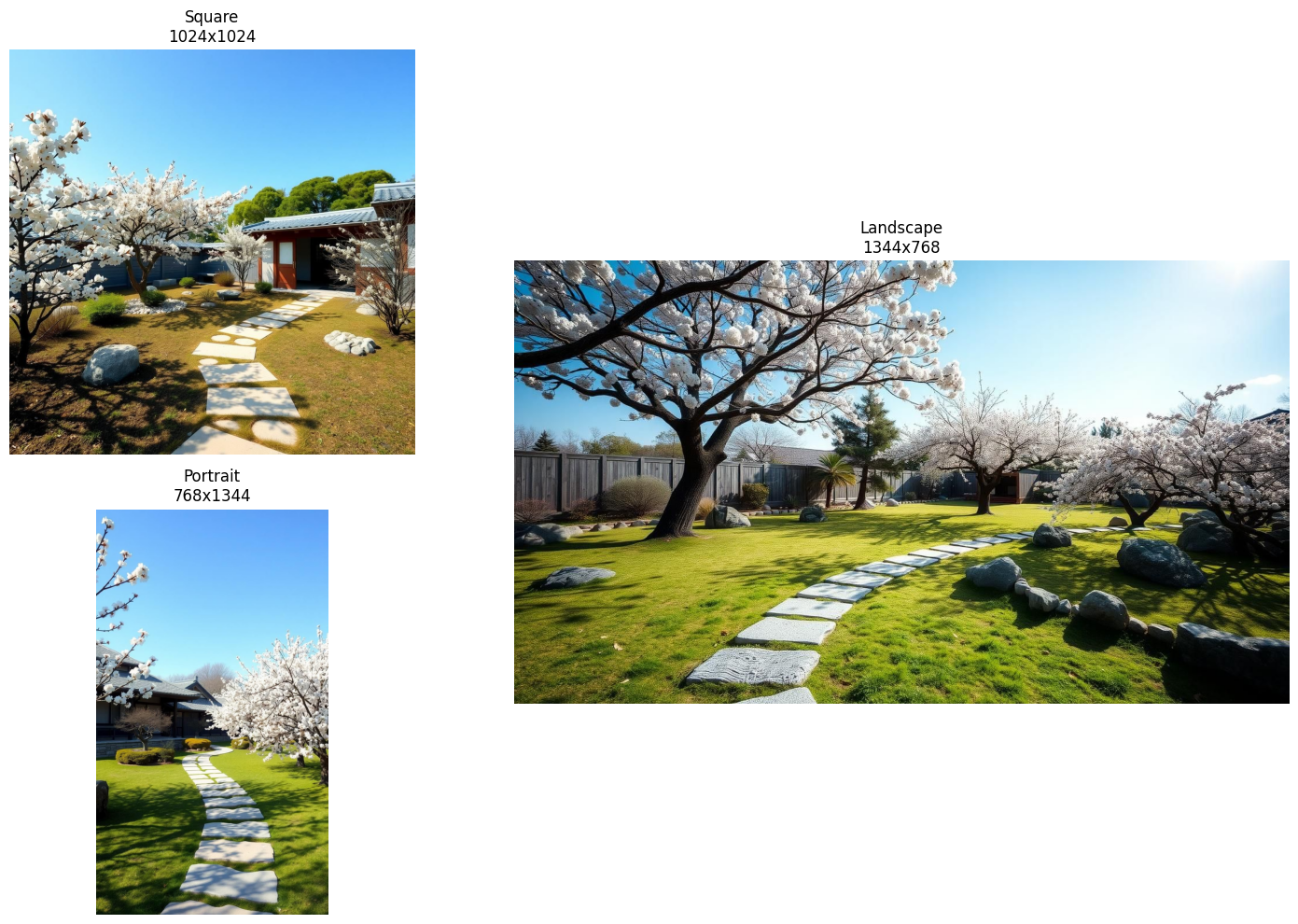
  • Square (1024 x 1024): social media posts, profile pictures.
  • Landscape (1344 x 768): banners, desktop wallpapers.
  • Portrait (768 x 1344): mobile wallpapers, posters.
Typical default: 1024 x 1024.
from together import Together

client = Together()

# Square: social media posts, profile pictures
response_square = client.images.generate(
    prompt="A peaceful zen garden with a stone path",
    model="black-forest-labs/FLUX.1-schnell",
    width=1024,
    height=1024,
    steps=4,
)

# Landscape: banners, desktop wallpapers
response_landscape = client.images.generate(
    prompt="A peaceful zen garden with a stone path",
    model="black-forest-labs/FLUX.1-schnell",
    width=1344,
    height=768,
    steps=4,
)

# Portrait: mobile wallpapers, posters
response_portrait = client.images.generate(
    prompt="A peaceful zen garden with a stone path",
    model="black-forest-labs/FLUX.1-schnell",
    width=768,
    height=1344,
    steps=4,
)
Reference image: dims.png
  • Square (1024 x 1024): social media posts, profile pictures.
  • Landscape (1344 x 768): banners, desktop wallpapers.
  • Portrait (768 x 1344): mobile wallpapers, posters.
Typical default: 1024 x 1024.
from together import Together

client = Together()

# Square: social media posts, profile pictures
response_square = client.images.generate(
    prompt="A peaceful zen garden with a stone path",
    model="black-forest-labs/FLUX.1-schnell",
    width=1024,
    height=1024,
    steps=4,
)

# Landscape: banners, desktop wallpapers
response_landscape = client.images.generate(
    prompt="A peaceful zen garden with a stone path",
    model="black-forest-labs/FLUX.1-schnell",
    width=1344,
    height=768,
    steps=4,
)

# Portrait: mobile wallpapers, posters
response_portrait = client.images.generate(
    prompt="A peaceful zen garden with a stone path",
    model="black-forest-labs/FLUX.1-schnell",
    width=768,
    height=1344,
    steps=4,
)
Reference image: dims.png

Quality and speedQuality and speed

steps

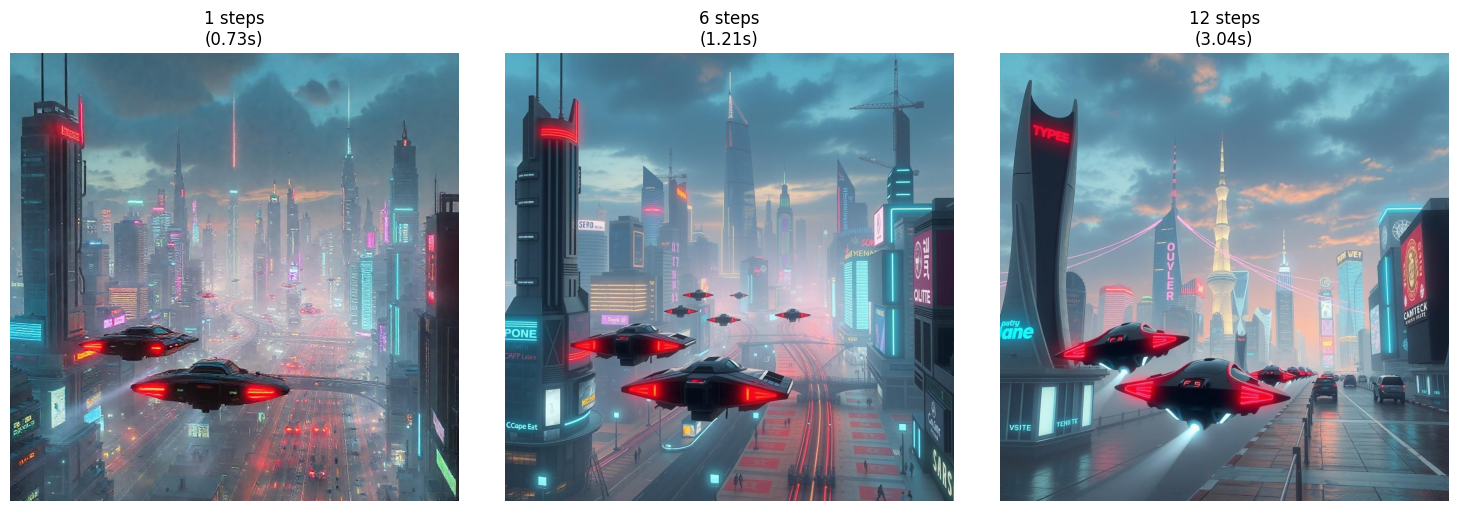
The number of diffusion steps. More steps generally improve quality at a near-linear cost in latency. Past a model-specific point, additional steps stop helping. Lower it (1-4) for fast iteration on FLUX Schnell. Raise it (30-40) for production-quality output on Pro and Dev models. Typical default: model-specific (often 20).
import time

from together import Together

client = Together()

prompt = "A majestic mountain landscape"
step_counts = [1, 6, 12]

for steps in step_counts:
    start = time.time()
    response = client.images.generate(
        prompt=prompt,
        model="black-forest-labs/FLUX.1-schnell",
        steps=steps,
        seed=42,  # Same seed for fair comparison
    )
    elapsed = time.time() - start
    print(f"Steps: {steps} - Generated in {elapsed:.2f}s")
Reference image: steps.png

guidance_scale

steps

The number of diffusion steps. More steps generally improve quality at a near-linear cost in latency. Past a model-specific point, additional steps stop helping. Lower it (1-4) for fast iteration on FLUX Schnell. Raise it (30-40) for production-quality output on Pro and Dev models. Typical default: model-specific (often 20).
import time

from together import Together

client = Together()

prompt = "A majestic mountain landscape"
step_counts = [1, 6, 12]

for steps in step_counts:
    start = time.time()
    response = client.images.generate(
        prompt=prompt,
        model="black-forest-labs/FLUX.1-schnell",
        steps=steps,
        seed=42,  # Same seed for fair comparison
    )
    elapsed = time.time() - start
    print(f"Steps: {steps} - Generated in {elapsed:.2f}s")
Reference image: steps.png

guidance_scale

Controls how closely the image follows the prompt. Higher values make the output more faithful to the prompt but can introduce artifacts and oversaturation. Lower values give the model more creative freedom. Raise it (8-10) when the model ignores parts of the prompt. Lower it (1-5) when output looks oversaturated, posterized, or “burned”. Typical default: 3.5.

Reproducibility and variations

seed

An integer that fixes the random initialization. With the same seed, prompt, model, and parameters, the model returns the same image. Useful for reproducibility, regression tests, and fair comparisons when tuning other parameters. Typical default: unset (each call returns a new image).

n

The number of images to generate per request. Each image appears as a separate entry in data. Higher values cost more (you pay for every image generated). Use it to compare variations of the same prompt in one call. Range: 1 to 4. Typical default: 1.

Output format

response_format

Controls how the image is returned. "url" (default) returns a hosted URL you can fetch later. "base64" embeds the image bytes directly in the response under b64_json, so you don’t need a second HTTP request. Use "base64" when you’re saving the image to a file, piping it elsewhere, or want to avoid an extra round trip. Typical default: "url".
from together import Together

client = Together()

response = client.images.generate(
    model="black-forest-labs/FLUX.1-schnell",
    prompt="a cat in outer space",
    response_format="base64",
)

print(response.data[0].b64_json)
When response_format is "base64", the response includes a b64_json field with the image encoded as a base64 string:
{
  "id": "oNM6X9q-2kFHot-9aa9c4c93aa269a2-PDX",
  "data": [
    {
      "b64_json": "/9j/4AAQSkZJRgABAQA",
      "index": 0,
      "type": null,
      "timings": {
        "inference": 0.7992482790723443
      }
    }
  ],
  "model": "black-forest-labs/FLUX.1-schnell",
  "object": "list"
}

output_format

The encoded image format: "jpeg" or "png". PNG preserves transparency and crisp edges but produces larger files. JPEG is smaller but lossy. Typical default: "jpeg".

Safety

disable_safety_checker

Disables the built-in NSFW safety checker. By default, requests that trigger the checker return 422 Unprocessable Entity. The checker runs on every model except FLUX Schnell Free and FLUX Pro. Typical default: false.
from together import Together

client = Together()

response = client.images.generate(
    prompt="a flying cat",
    model="black-forest-labs/FLUX.1-schnell",
    steps=4,
    disable_safety_checker=True,
)

print(response.data[0].url)

Capability-specific parameters

These parameters belong to features with their own dedicated pages or schemas. Each link below covers supported models and end-to-end examples. Controls how closely the image follows the prompt. Higher values make the output more faithful to the prompt but can introduce artifacts and oversaturation. Lower values give the model more creative freedom. Raise it (8-10) when the model ignores parts of the prompt. Lower it (1-5) when output looks oversaturated, posterized, or “burned”. Typical default: 3.5.

Reproducibility and variations

seed

An integer that fixes the random initialization. With the same seed, prompt, model, and parameters, the model returns the same image. Useful for reproducibility, regression tests, and fair comparisons when tuning other parameters. Typical default: unset (each call returns a new image).

n

The number of images to generate per request. Each image appears as a separate entry in data. Higher values cost more (you pay for every image generated). Use it to compare variations of the same prompt in one call. Range: 1 to 4. Typical default: 1.

Output format

response_format

Controls how the image is returned. "url" (default) returns a hosted URL you can fetch later. "base64" embeds the image bytes directly in the response under b64_json, so you don’t need a second HTTP request. Use "base64" when you’re saving the image to a file, piping it elsewhere, or want to avoid an extra round trip. Typical default: "url".
from together import Together

client = Together()

response = client.images.generate(
    model="black-forest-labs/FLUX.1-schnell",
    prompt="a cat in outer space",
    response_format="base64",
)

print(response.data[0].b64_json)
When response_format is "base64", the response includes a b64_json field with the image encoded as a base64 string:
{
  "id": "oNM6X9q-2kFHot-9aa9c4c93aa269a2-PDX",
  "data": [
    {
      "b64_json": "/9j/4AAQSkZJRgABAQA",
      "index": 0,
      "type": null,
      "timings": {
        "inference": 0.7992482790723443
      }
    }
  ],
  "model": "black-forest-labs/FLUX.1-schnell",
  "object": "list"
}

output_format

The encoded image format: "jpeg" or "png". PNG preserves transparency and crisp edges but produces larger files. JPEG is smaller but lossy. Typical default: "jpeg".

Safety

disable_safety_checker

Disables the built-in NSFW safety checker. By default, requests that trigger the checker return 422 Unprocessable Entity. The checker runs on every model except FLUX Schnell Free and FLUX Pro. Typical default: false.
from together import Together

client = Together()

response = client.images.generate(
    prompt="a flying cat",
    model="black-forest-labs/FLUX.1-schnell",
    steps=4,
    disable_safety_checker=True,
)

print(response.data[0].url)

Capability-specific parameters

These parameters belong to features with their own dedicated pages or schemas. Each link below covers supported models and end-to-end examples.
  • image_url and reference_images: Edit or compose an existing image. Used by the Kontext family, FLUX.2, and Google models. See Reference images.
  • frame_images: Required keyframes for video generation with the Kling model.
  • image_loras: Apply LoRA adapters to influence style. See the API reference for the full object schema.

See also