Generating an image
To query an image model, use the .images method and specify the image model you want to use.
client = Together()
# Generate an image from a text prompt
response = client.images.generate(
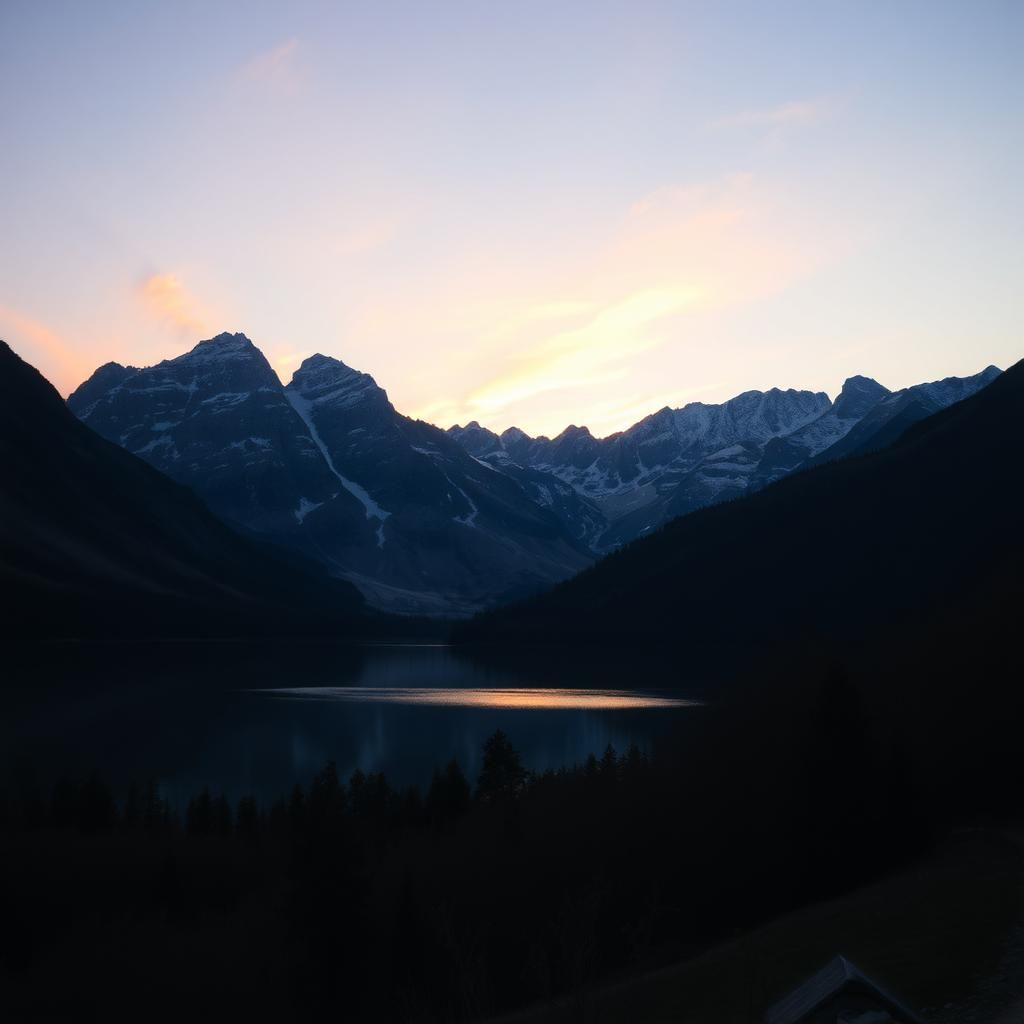
prompt="A serene mountain landscape at sunset with a lake reflection",
model="black-forest-labs/FLUX.1-schnell",
steps=4,
)
print(f"Image URL: {response.data[0].url}")
Example response structure and output:
{
"id": "oFuwv7Y-2kFHot-99170ebf9e84e0ce-SJC",
"model": "black-forest-labs/FLUX.1-schnell",
"data": [
{
"index": 0,
"url": "https://api.together.ai/v1/images/..."
}
]
}
Provide reference image
Some image models support editing or transforming an existing image. The parameter you use depends on the model:
| Parameter | Type | Models | Description |
|---|
image_url | string | FLUX.1 Kontext (pro/max), FLUX.2 (pro/flex) | A single image URL to edit or transform |
reference_images | string[] | FLUX.2 (pro/dev/flex), Gemini 3 Pro Image, Flash Image 2.5 | An array of image URLs to guide generation |
reference_images is recommended for FLUX.2 and Google models as it supports multiple input images. FLUX.2 [pro] and [flex] also accept image_url for single-image edits, but FLUX.2 [dev], Gemini 3 Pro Image, and Flash Image 2.5 only support reference_images.
Using image_url (Kontext models)
from together import Together
client = Together()
response = client.images.generate(
model="black-forest-labs/FLUX.1-kontext-pro",
width=1024,
height=768,
prompt="Transform this into a watercolor painting",
image_url="https://cdn.pixabay.com/photo/2020/05/20/08/27/cat-5195431_1280.jpg",
)
Example output:
Using reference_images (FLUX.2 & Google models)
from together import Together
client = Together()
response = client.images.generate(
model="black-forest-labs/FLUX.2-pro",
width=1024,
height=768,
prompt="Replace the color of the car to blue",
reference_images=[
"https://images.pexels.com/photos/3729464/pexels-photo-3729464.jpeg"
],
)
For more details on multi-image editing, image indexing, and color control with FLUX.2, see the FLUX.2 Quickstart.
Supported Models
See our models page for supported image models.
Parameters
| Parameter | Type | Description | Default |
|---|
prompt | string | Text description of the image to generate | Required |
model | string | Model identifier | Required |
width | integer | Image width in pixels | 1024 |
height | integer | Image height in pixels | 1024 |
n | integer | Number of images to generate (1-4) | 1 |
steps | integer | Diffusion steps (higher = better quality, slower) | 1-50 |
seed | integer | Random seed for reproducibility | any |
negative_prompt | string | What to avoid in generation | - |
image_url | string | URL of a reference image to edit. Used by Kontext models. | - |
reference_images | array | Array of image URLs for image-to-image editing. Used by FLUX.2 and Google models. | - |
frame_images | array | Required for Kling model. Array of images to guide video generation, like keyframes. | - |
prompt is required for all models except Kling
width and height will rely on defaults unless otherwise specified - options for dimensions differ by model
- Flux Schnell and Kontext [Pro/Max/Dev] models use the
aspect_ratio parameter to set the output image size whereas Flux.1 Pro, Flux 1.1 Pro, and Flux.1 Dev use width and height parameters.
Generating Multiple Variations
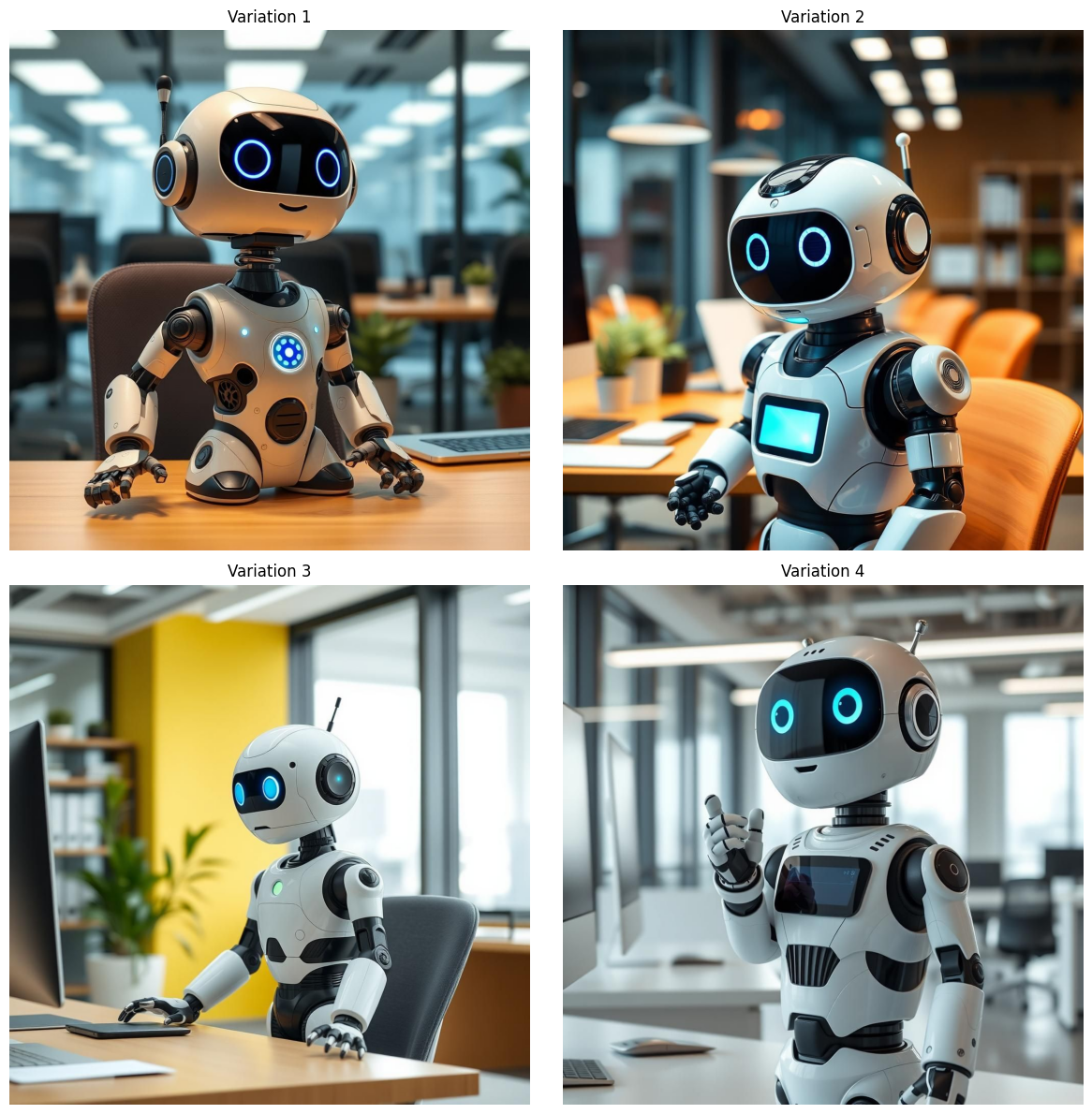
Generate multiple variations of the same prompt to choose from:
response = client.images.generate(
prompt="A cute robot assistant helping in a modern office",
model="black-forest-labs/FLUX.1-schnell",
n=4,
steps=4,
)
print(f"Generated {len(response.data)} variations")
for i, image in enumerate(response.data):
print(f"Variation {i+1}: {image.url}")
Example output:
Custom Dimensions & Aspect Ratios
Different aspect ratios for different use cases:
# Square - Social media posts, profile pictures
response_square = client.images.generate(
prompt="A peaceful zen garden with a stone path",
model="black-forest-labs/FLUX.1-schnell",
width=1024,
height=1024,
steps=4,
)
# Landscape - Banners, desktop wallpapers
response_landscape = client.images.generate(
prompt="A peaceful zen garden with a stone path",
model="black-forest-labs/FLUX.1-schnell",
width=1344,
height=768,
steps=4,
)
# Portrait - Mobile wallpapers, posters
response_portrait = client.images.generate(
prompt="A peaceful zen garden with a stone path",
model="black-forest-labs/FLUX.1-schnell",
width=768,
height=1344,
steps=4,
)
Quality Control with Steps
Compare different step counts for quality vs. speed:
import time
prompt = "A majestic mountain landscape"
step_counts = [1, 6, 12]
for steps in step_counts:
start = time.time()
response = client.images.generate(
prompt=prompt,
model="black-forest-labs/FLUX.1-schnell",
steps=steps,
seed=42, # Same seed for fair comparison
)
elapsed = time.time() - start
print(f"Steps: {steps} - Generated in {elapsed:.2f}s")
Base64 Images
If you prefer the image data to be embedded directly in the response, set response_format to “base64”.
from together import Together
client = Together()
response = client.images.generate(
model="black-forest-labs/FLUX.1-schnell",
prompt="a cat in outer space",
response_format="base64",
)
print(response.data[0].b64_json)
When you do, the model response includes a new b64_json field that contains the image encoded as a base64 string.
{
"id": "oNM6X9q-2kFHot-9aa9c4c93aa269a2-PDX",
"data": [
{
"b64_json": "/9j/4AAQSkZJRgABAQA",
"index": 0,
"type": null,
"timings": {
"inference": 0.7992482790723443
}
}
],
"model": "black-forest-labs/FLUX.1-schnell",
"object": "list"
}
Safety Checker
We have a built in safety checker that detects NSFW words but you can disable it by passing in disable_safety_checker=True. This works for every model except Flux Schnell Free and Flux Pro. If the safety checker is triggered and not disabled, it will return a 422 Unprocessable Entity.
from together import Together
client = Together()
response = client.images.generate(
prompt="a flying cat",
model="black-forest-labs/FLUX.1-schnell",
steps=4,
disable_safety_checker=True,
)
print(response.data[0].url)
Troubleshooting
Image doesn’t match prompt well
- Make prompt more descriptive and specific
- Add style references (e.g., “National Geographic style”)
- Use negative prompts to exclude unwanted elements
- Try increasing steps to 30-40
Poor image quality
- Increase
steps to 30-40 for production
- Add quality modifiers: “highly detailed”, “8k”, “professional”
- Use negative prompt: “blurry, low quality, distorted, pixelated”
- Try a higher-tier model
Inconsistent results
- Use
seed parameter for reproducibility
- Keep the same seed when testing variations
- Generate multiple variations with
n parameter
Wrong dimensions or aspect ratio
- Specify
width and height explicitly
- Common ratios:
- Square: 1024x1024
- Landscape: 1344x768
- Portrait: 768x1344
- Ensure dimensions are multiples of 8