

Requirements
- The same requirements as single-turn GRPO: a model with generator support, and a model resource with
num_generator_replicasof 1 or more. - A cookbook checkout, which provides the environment abstractions in
post_training_cookbook.envs.
How an episode runs
Each episode starts from aTask, which carries the prompt, the target the reward checks against, and any metadata the environment needs. The loop then alternates between the model and the environment:
- The environment’s
reset(task)returns the opening messages, typically a system prompt and the user prompt. - The loop renders the messages and the environment’s tool specs through the model’s codec, samples an assistant message, and parses it back into a structured message with any tool calls.
- The environment’s
step(message)consumes the assistant message, executes any tool calls, appends the results, and returns aStepResultwith the updated history, a reward, and whether the episode is over. - Steps 2 and 3 repeat until the environment terminates the episode, the loop truncates it, or
max_turnsassistant turns have run.
episodes_per_task is the multi-turn counterpart of group_size in single-turn training. Each task runs that many episodes, and advantages are computed across them.
Write an environment
SubclassEnv and implement its four members: reset, step, tool_specs, and messages. The environment owns the conversation history, tool dispatch, and the rule for when an episode ends. The loop owns tokenization and sampling.
Task: The spec for one episode, withprompt,target, andmetadatafields.Tool: Anything withname,description,parameters_schema, and anasync execute(arguments) -> ToolResultmethod.tool_to_specconverts a tool into the schema the codec renders into the prompt.ToolResult: The return value ofexecute. Setshould_stop=Trueto ask the environment to end the episode. Yourstepdecides how to honor the request. The cookbook’s reference environment returnsterminated=True.StepResult: The return value ofstep.terminatedmeans task logic ended the episode, for example on a final answer.truncatedmeans an external policy ended it.rewardis the episode’s reward when it ends. The loop readsrewardandmetricsonly from the step that ends the episode, so intermediate steps usually return0.0and diagnostics belong in the final step’smetrics.close(): Override it whenresetstarts background work, such as a subprocess or a connection. It runs even when the loop truncates the episode and the environment never sees a terminalstep.
ToolUseGameEnv in post_training_cookbook/envs/tool_use_game/. It provides list_fact_keys, lookup, and calculator tools and a bundled task list.
Run multi-turn training
Calltrain_multi_turn with your tasks, a factory that builds a fresh environment for each episode, and a config that sets max_turns:
recipes/grpo/tool_use_game.py recipe. These settings are specific to multi-turn training:
How episodes become training samples
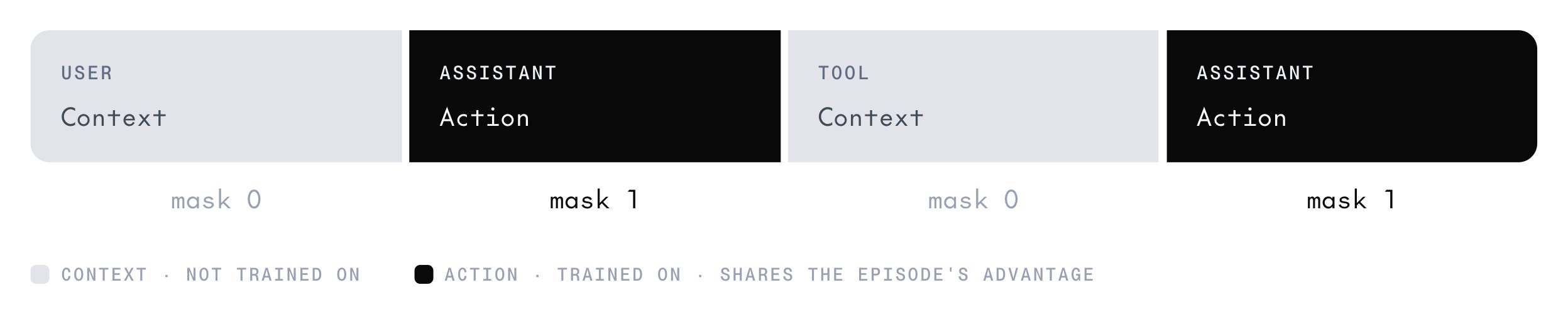
0, so the model isn’t trained to predict the prompt or the tool results. Action segments get loss mask 1, and every action in the episode carries the episode’s advantage.
When the chat template strips earlier content from history, such as a reasoning model’s <think> blocks, the collector starts a new sample at that point, so the tokens stay aligned with the log-probabilities the generator recorded. Thinking settings covers the options that control this.
Truncation
An episode that doesn’t reach a terminalstep is truncated. The cause determines whether the soft overlong penalty is added to the episode’s reward. Only the two length-budget causes add it:
With
overlong_masking=True, truncated episodes of any cause are dropped before samples are built, but their rewards still count toward the group baseline.
To track how episodes end, watch the multi-turn metrics in the step log: terminated_ratio, truncated_ratio, context_overflow_ratio, and parse_failure_ratio.
Score a hosted model first
Before you spend GPU time, use the cookbook’spost_training_cookbook.serverless_eval package to get a baseline score for your environment. Its run_and_report function runs any Env against a hosted chat model without a training session. For a worked example, see recipes/serverless_eval/tool_use_game.py. Check a baseline before training explains how to read the score.
Next steps
Reinforcement learning with GRPO
Clipping, dynamic sampling, overlong handling, and async training.
Reward functions
Design guidance that applies to episode rewards too.
Monitoring
The multi-turn and async metrics.
Cookbook reference
Every GRPO config field, including the multi-turn ones.